Women and culture are at the heart of her work!
What is the theme and significance of the costumes and accessories, which are central elements of your works?
As a member of the Lébou* community, I decided to focus on the attire of these women (clothing and accessories) during the Ndawrabine and Goumbé dances. Lébou* culture is rich in festivities such as the Ndawrabine and the Goumbé, which are the main dances performed during the community’s ceremonies and rituals. These take the form of a procession accompanied by choreography, in which young people – often from the same generation – come together. The women line up in two or three columns, moving their bodies forwards in unison. A demonstration can be seen in this video… The choreography is obviously important, but the costumes and accessories are the elements that stand out most aesthetically. The women wear two large boubous in different colour tones that billow with the movements of their bodies. As for accessories, the women wear traditional beaded pendants in various colours, as well as gold- and silver-coloured necklaces known as ‘libidor’; they also wear jewellery called ‘Diibé’ in two shades of red and yellow. As an artist, I add my own touch by incorporating objects from the sea, such as shells and the like, to highlight the connection between the sea and the Lébou people.
Why have you painted the faces white and without any details?
The faces painted white are a continuation of my work at the Dakar School of Arts. For my final-year exam, I worked on the Tadjabone, which is a typically Senegalese carnival, rich in movement and colour. It is a folk festival celebrated mainly by young people in Senegal during the Tamxarit (Ashura). During this carnival, girls dress up as boys and boys as girls. They paint their faces with white charcoal ash or white powder. They then roam the streets singing and dancing, going from house to house to ask for New Year’s gifts and receiving food or money in return. This piece is therefore a continuation of my work, with a nod to this local tradition. 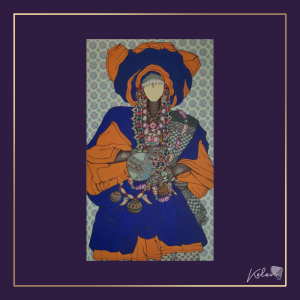
Wanema, acrylic on canvas, 140cm x 120cm
How do you work on colour harmony? And how long does it take you to complete a painting?
When it comes to colours, I’m always looking for balance, contrast and energy to achieve an aesthetically pleasing result in the finished painting. The time it takes to complete a painting obviously depends on the size, but also on the technique used. For example, the flat-colour technique is very time-consuming as it is not easy to execute. It is difficult to give a precise timeframe. Working day and night, I can complete a piece in 15 days, but on average it takes me at least 30 days.
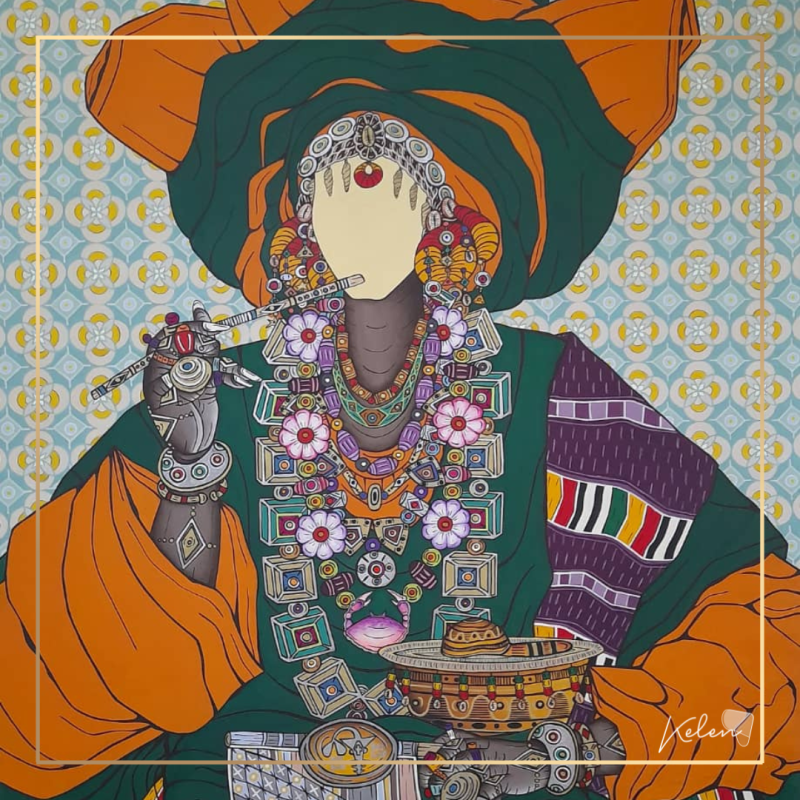
Wanéma, acrylic on canvas, 140cm x 120cm
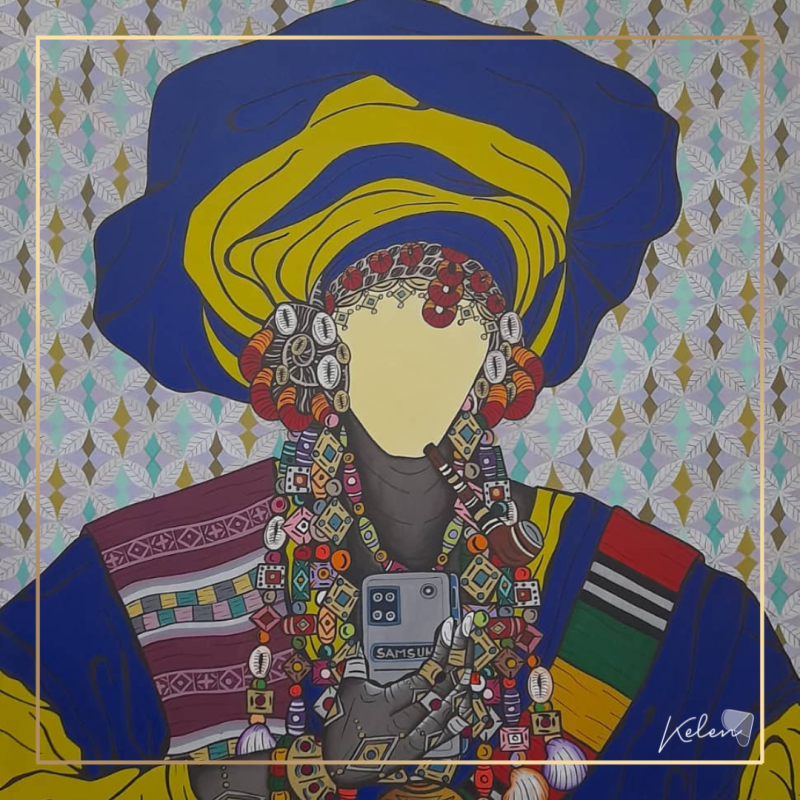
Goumbéléné, acrylic on canvas, 180cm x 120cm
*The Lebou This community, which is dear to the artist Ibrahima Gningue, traditionally consists of fishermen as well as farmers. It is concentrated on the Cape Verde Peninsula (Dakar), which they were already inhabiting when the first settlers arrived in the region. They have spoken Wolof (a language mainly spoken in Senegal) since time immemorial. They are now predominantly Muslim but have retained practices derived from their traditional religion.