Raymond Yves Kono is a Cameroonian artist whose vibrant works capture colourful scenes from everyday life. He focuses on ‘the spirit’ through his unique characters.
What is your background?
I hold a Bachelor’s degree in Fine Art and Art History from the University of Yaoundé 1. I undertook a three-year course in screen printing, followed by a series of workshops and inspiring encounters.
How did your calling as an artist come about?
I’d say it all began with childhood memories, and my ability to reproduce and give shape to the things I feel and imagine, usually quite spontaneously.
When we used to go on holiday to my mother’s village – I was about six or seven at the time – I would watch my great-grandmother making clay pots and decorating them with twigs. I’d noticed that her eyes were completely white. It was only later that I realised she was blind…
"Friend: What’s your degree course?
Raymond: Visual Arts.
Friend: ‘Do you make plastics?’”
It’s funny, but it also masks a deep sense of despair among young people – and even among parents. After that question came the next: “And with this degree, which entrance exams will you sit?” and so on… University seemed to me to be a place of frustration and despair for many people, but that wasn’t the case for me. And as the eldest in the family, all these trials led me to the motto that guided my choice: ‘Turn my passion into a profession’.
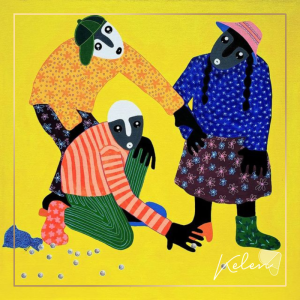
Marble Games Series
Tell us about your work
My work has evolved and the different techniques sometimes overlap. I move from collage to acrylics to oil painting, via cut-outs. But for several years now, I’ve been sticking to acrylics.
I start with a drawing. Once the drawing is on the canvas, I add colours according to my mood. Most often, these are bright colours. The human-like figures are spirits, which I have named ‘Ntshi-Ntshim’ (in the Éton language). They embody the stylistic codes of Fang statuary (a Bantu ethnic group found in Central Africa) – part-child, part-adult, neither too tall nor too short. Added to this duality is the avoidance of eye contact, which I symbolise through turned-away or upside-down heads. Part of this artistic approach echoes Sartre’s thinking when he said:‘The gaze of the other judges me; hell is the other; The gaze of the other objectifies me; And for fear of dying of boredom, I’d rather die of laughter...”
I create scenes tinged with irony; I play with clothing (colourful underpants, T-shirts, socks, caps, kepis); some figures have no shoes on one foot, and sometimes I also depict them wearing a sock on one foot whilst the other is bare. This is my way of expressing a sense of lack. It seems you can’t have it all in life! In fact, it’s the combination of these elements that creates this effect. And as an artist, I like to place them in a space where they appear to be levitating.
What are your artistic inspirations?
I draw inspiration from what I read, and above all from my musical tastes. There are also all my day-to-day experiences, both good and not so good, which I try to turn to my advantage. Don’t forget, I’d rather die of laughter than of boredom…
Colour is important in your work; what does it mean to you?
I see colour as a remedy, a medicine. Generally speaking, colour eases my sorrows. It’s my own personal form of therapy… Colour is the answer!
Discover Raymond’s works at the Art Kelen gallery
Follow Art Kelen on Facebook and Instagram for even more news and content on contemporary African art.