
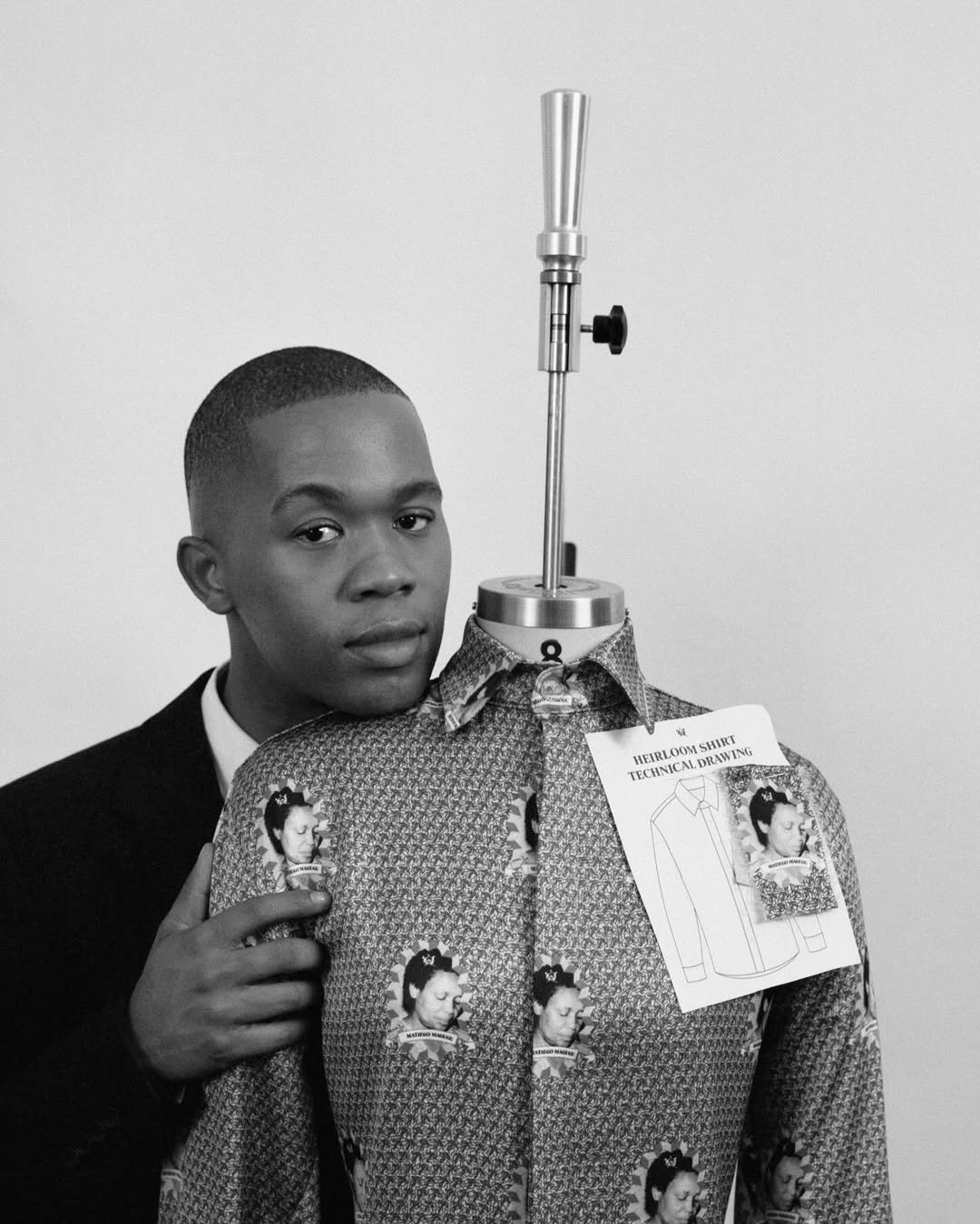
Two years ago, designer Thebe Magugu became the first African designer to win the LVMH Prize, one of the industry’s most prestigious awards. This provided a wonderful international platform for this young talent, whilst also shining a spotlight on the continent’s contemporary design scene as a whole.
This young designer, originally from Kimberley and based in Johannesburg, launched his women’s ready-to-wear brand in 2015 after gaining experience working with various labels and designers. He also studied design, fashion and photography at the LISOF School of Fashion in Johannesburg, one of Africa’s leading fashion schools.
His label, which bears his name, celebrates his African cultural roots with a modern approach.
He aims to elevate the often overly clichéd perception of African fashion by offering his customers luxury ready-to-wear clothing that is culturally rich, high-quality and modern, featuring original patterns and references to his African roots.
Every stage of the supply chain, from manufacturing to production, takes place on the continent. Thebe Magugu dreams of employing more artisans in South Africa, where the youth unemployment rate stands at 30 per cent. “That’s huge! I want to do my bit,” he told the press.
It is important that his customers are informed about the origin of the materials used. He therefore embeds a microchip in every garment, using an app called Verisium. This technology can be used to display a description of the manufacturing process, a picture of everyone who worked on the garment and the overall story behind the collection.
Thebe Magugu – The ‘art history’ collection.
The collection that won the LVMH Prize is called “Prosopography” and is inspired by the Black Sash – the white women who, from the 1950s onwards, stood up to apartheid in South Africa.
“We often hear about Desmond Tutu and Nelson Mandela. However, there are quieter voices, whose stories are lost in the historical record, but who also played an important role in the struggle for freedom,” explains Magugu.Thebe Magugu has no plans to leave South Africa, despite his international ambitions. “When I presented my collection to the jury, I said that my dream was to build a global brand that could be exported everywhere,” says the designer. “But I also told them that, for me, it was important to remain based in my own country. My mission has always been to showcase contemporary South Africa. I want to put an end to certain rather simplistic stereotypes about Africa and fashion from this continent,” the designer insists.
However, many obstacles remain, particularly in terms of logistics.
“The only thing that poses a problem for me is distribution, particularly transport. It’s so easy to import into South Africa, but it’s very difficult to export from here,” he says, highlighting one of the major challenges faced by designers on the continent.