
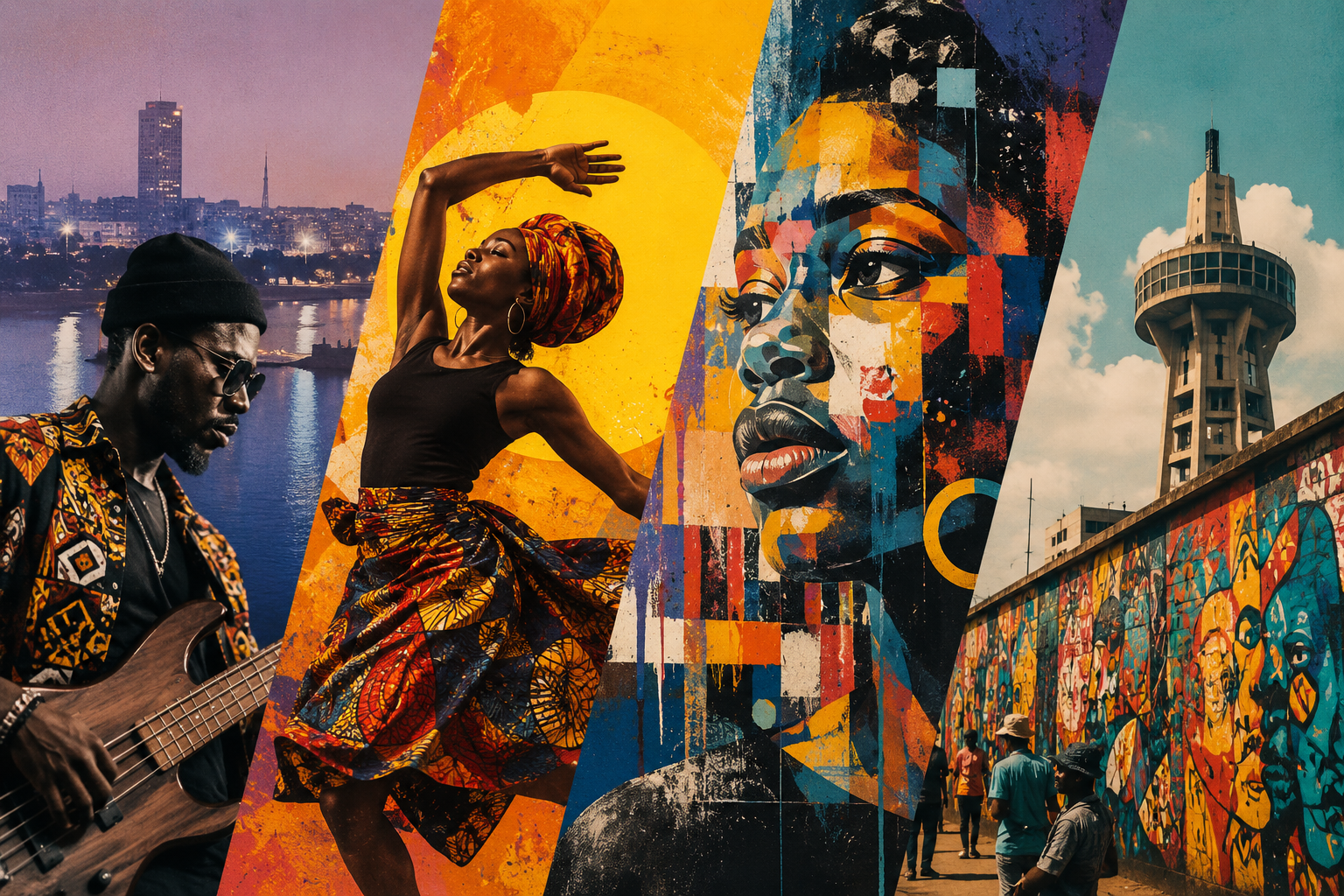
Aerial view of Kinshasa with the River Congo in the background – Clément Bonnerot
Kinshasa, the capital of the DRC and the country’s largest city, is also the third most populous city in Africa, with estimates ranging from 13 to 17 million inhabitants. Kinshasa is the economic, political and cultural heart of the country, and the headquarters of major international institutions.
A capital with many faces, a globalised megacity-village, it is undeniably a city of contrasts, multicultural by nature, home to representatives of the 450 Congolese ethnic groups, but also a historic haven for many foreign communities.
Kinshasa is a paradoxical megacity: the city is plagued by poverty whilst the country is extremely rich in minerals. Despite everything, the will to live, the dynamism of local cultures and the vibrant display of artistic and cultural expression shape the character of the people of Kinshasa.
In his documentary *Système K* – named after Kinshasa – French director Renaud Barret meets eight artists who display remarkable resilience. They are sculptors, painters, visual artists and musicians; they create installations using their own bodies and work with recycled materials and urban waste. They do not exhibit their work or stage their performances in enclosed spaces. Their preferred stage is the street, and their audience comes from the streets themselves.
A spotlight on artists who offer their interpretation – by turns sombre and joyful – of a city where art is invented on every street corner.
The art of creation
A collective of ‘sapeur’ performers, Les Justiciers de la Sape, design and produce their own clothes, drawing inspiration from Japanese fashion houses such as Yoji Yamamoto and Kenzo. Here, they pay tribute to the late musician Papa Wamba, ‘the prince of sape’, by recreating some of his most iconic stage poses.
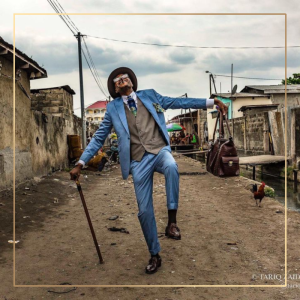 Tariq Zaidi
Ecological art
Many African artists are committed to social causes, and their artistic approach aims to raise awareness of environmental, political and social challenges. They are keen to showcase the reality of today’s societies. Emmanuel Botalatala, a 60-year-old Congolese artist and self-proclaimed “Minister of Rubbish”. He creates works of art from waste that he collects, sculpts and incorporates into compositions glued onto wooden or cardboard panels painted by his own hand. He observes, helplessly, the deteriorating state of Kinshasa – an open-air rubbish dump – where everything is thrown onto the ground indiscriminately and without a second thought. His difficult yet inspiring journey has been the subject of a documentary, *Le ministre des poubelles*.
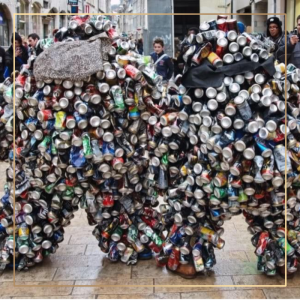 Les Justiciers de la sape © Renaud Barret
Eddy Ekete is a visual artist who works across several artistic fields: painting, sculpture and performance. He consistently engages his artistic practice with the urban environment. His work is thus imbued with anthropological observations. He is committed to always creating his work as a mirror of the world around him.
Politically Engaged Art
Freddy Tsimba is a sculptor born in Kinshasa in 1967. He completed his studies at the Kinshasa Academy of Fine Arts, specialising in monumental sculpture, in 1989 and has been working with bronze and cement ever since. He owes his reputation to more than fifty exhibitions across Africa, Europe, Canada and China. He has received numerous awards and honours in France and Canada. Through his work, he denounces the tragedies caused by war. Freddy Tsimba is particularly known for his monumental street installations using materials from conflicts, such as bullet casings and machetes.
‘My real school, even though I studied at the Kinshasa School of Fine Arts, is the street, where I find an abundance of materials. My teachers were the blacksmiths with whom, for five years, I learnt the techniques of fire and welding.’
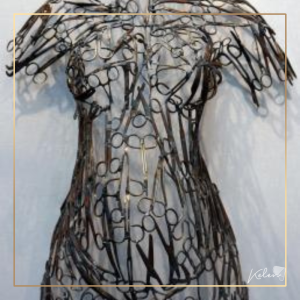 Scissors Woman
The art of resourcefulness
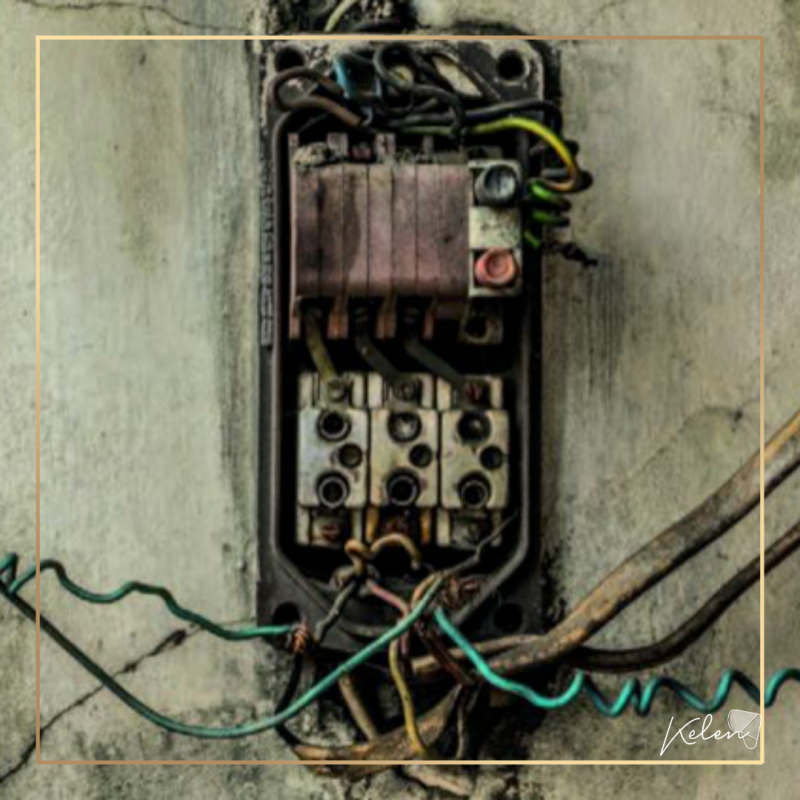
Dareck Tubazaya evokes, with humour and realism, the ‘resourcefulness’ of the people of Kinshasa, notably through a photograph of an old electricity meter with a tangle of wires, entitled *Benda courant* – a Lingala expression denoting the art of tapping into the electricity supply.
Boms Liteli, a member of the KOKOKO! collective, is an instrument designer. In his open-air workshop, he produces one-off pieces which he electrifies using trial and error to create original electronic music that is now making its mark on the international scene.
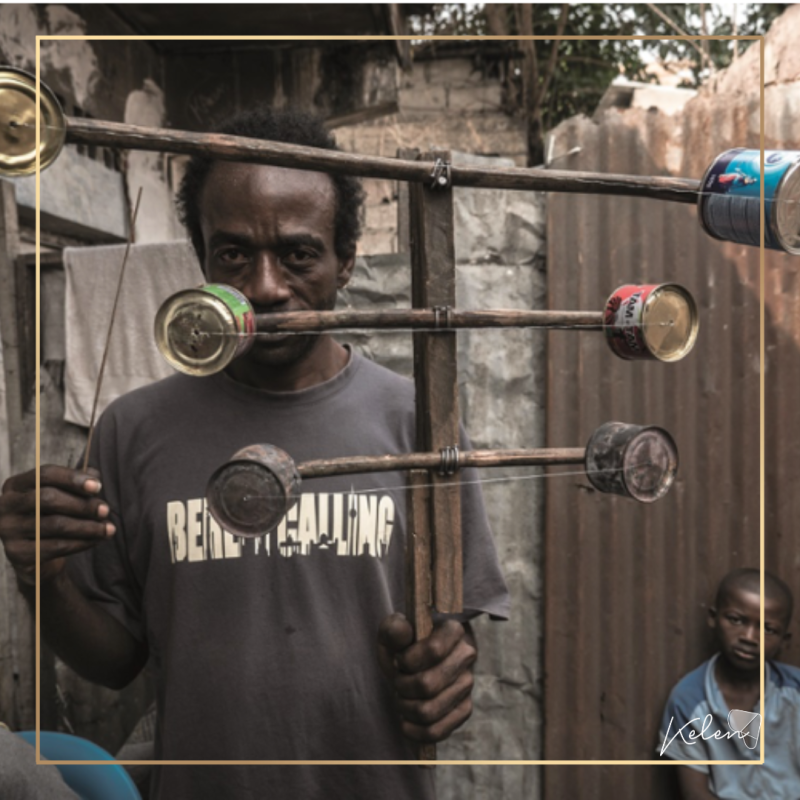 The Lan-Gong guitar © Renaud Barret
Introspective art
Géraldine Tobé was born in 1992 in Kinshasa. She studied at the Kinshasa Institute of Fine Arts, the city where she still lives and works. She uses fire – the source of childhood injuries and fears – to create introspective art. Indeed, she belongs to that generation of children accused of witchcraft and subjected to attempted exorcisms by pastors in Kinshasa. Géraldine Tobé creates her paintings using soot and smoke from candles and paraffin lamps. 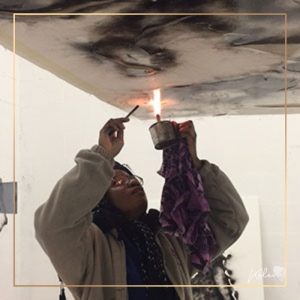
Follow Art Kelen on Facebook and Instagram for even more news and content on contemporary African art.