Traditional art…
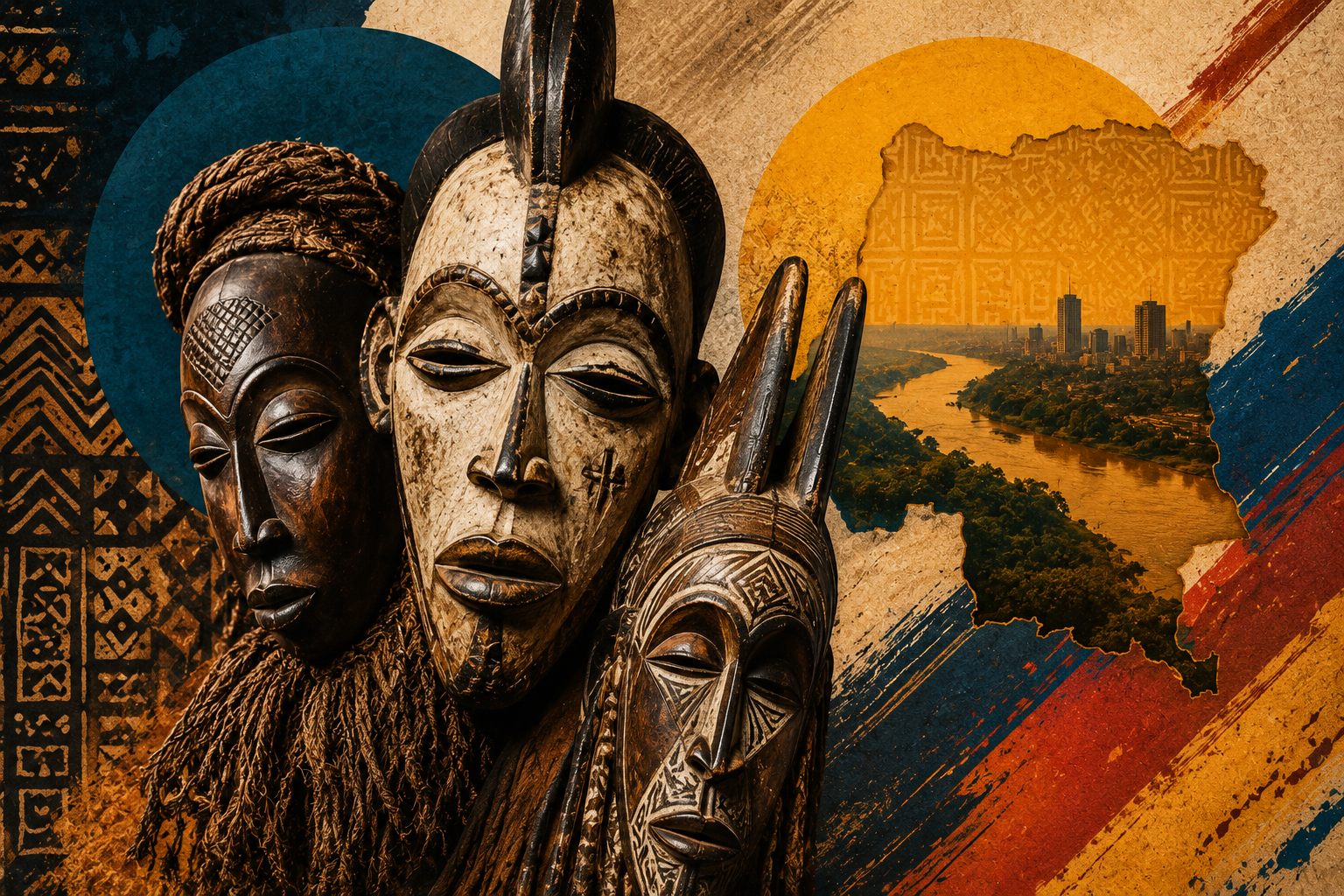
Traditional Congolese art is particularly rich and varied. It comprises Kuba, Tshokwe, Songye and Pende art forms, which are a source of pride for the country’s various regions and ethnic groups. These art forms excel in fields as diverse as sculpture, statuary, weaving, ceramics and tapestry.
Kuba art
The name ‘Kuba’ means ‘People of the Lightning’. Of all the great pre-colonial kingdoms of the DRC, only that of the Kuba survived the colonial era. There are three reasons for this survival: the strength of the central political organisation on the eve of the colonial conquest, the quasi-sacred status of the king in the eyes of his subjects, and the extraordinary reputation of Kuba art. Kuba art is, first and foremost, a royal and aristocratic art form. It is characterised by an exceptional sense of form and colour. It takes the form of statues, combs, razor holders, stylised cosmetic boxes, cephalomorphic bowls, dance masks, and fabrics woven from raffia fibre and embroidered. 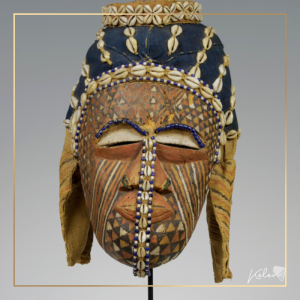
Tshokwe art
The Tshokwe (or Chokwe) inhabit a vast region on the border between Angola and the Democratic Republic of the Congo. Tshokwe art is characterised by its great diversity: masks made of wood or fragile resin, sceptres adorned with figures of chiefs, carved seats… But also small objects such as whistles and a wealth of statuary depicting chiefs or chiefs’ wives, whose exact roles are not fully understood, always carved from dark-coloured wood. 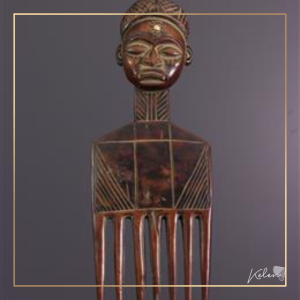
Songye art
The Songye are a people living in the wooded savannahs of the south-east of the Democratic Republic of the Congo. The Songye have created some of the most impressive masks in Black African art. These masks are ceremonial objects that still play a prestigious role amongst the Songye of the East today. 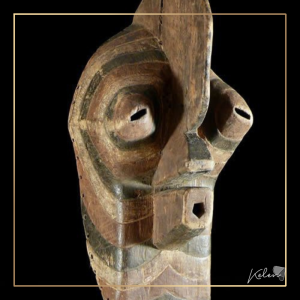
Pende Art
Known as one of the few peoples to have had the audacity to confront the firepower of the Portuguese invaders, this people were nicknamed by their neighbours — who regarded their attitude as bordering on recklessness — the Pendé: meaning ‘the rebels ’. Pende art is extremely prolific and features a vast array of masks, each more inventive and astonishing than the last. 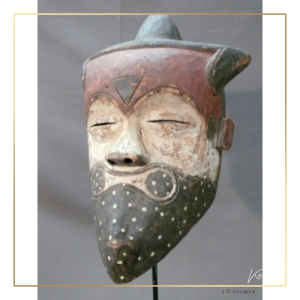
...To contemporary art
The 1930s: the dawn of contemporary art Modern art in the DRC emerged from its contact with the West. The artistic tradition was influenced by the use of new media and tools from Europe. The beginnings of contemporary art are dated to the 1930s, during the era of the Belgian Congo. Two pioneering artists emerged from this period, supported by the Belgian administrator Georges Thiry: Lubaki and Djilatendo. Fascinated by their drawings on huts, Georges Thiry provided them with paper and watercolours so that they could reproduce their works on a more durable medium. Their drawings are often figurative, sometimes abstract. They explore themes linked to nature, everyday life, local legends and dreams. Lubaki’s watercolours were exhibited for the first time in 1929 in Europe, at the Palais des Beaux-Arts in Brussels.
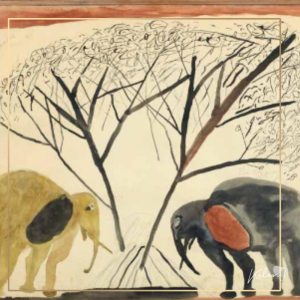
Albert Lubaki
The 1940s and 1950s: the emergence of art academies
In 1946, nearly twenty years after the discovery of the pioneering artists, Pierre Romain-Desfossés founded the Académie d’Art Indigène in Elisabethville (now Lubumbashi), better known as the ‘Atelier du Hangar’. The French patron’s aim was not to teach his pupils to paint in the European style, but rather to help them express their art and personality by drawing on ancestral traditions of representation. Three artists stood out at the Atelier du Hangar for their distinctive styles: Bela, Pilipili Mulongoy and Mwenze Kibwanga The Kinshasa Academy of Fine Arts was founded in 1943 as a school, before adopting its definitive name in 1957. The Academy of Fine Arts in Elisabethville, founded in 1951, was one of the first interracial schools in the Belgian Congo and offered courses in drawing, architecture, ceramics, painting and sculpture.
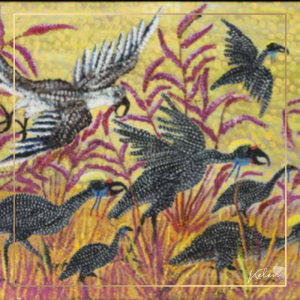 Bela (1918–1973)
The 1970s: the emergence of folk art
During the post-colonial period, folk art emerged with the ‘Art partout’ exhibition held in Kinshasa in 1978. This movement brought to an end a period in which contemporary art had been caught between Western influence and the assertion of an African art form. The leading artists were Chérif Samba, Moke, Pierre Bodo and Chéri Chérin. Their subjects were rooted in political and social criticism. The paintings sometimes feature explanatory texts blending humour and derision. This strand of folk art is carried on today by a new generation of artists, the best known of whom are JP Mika and Monsengo Shula. Mika is the youngest of the folk painters exhibited in Paris.
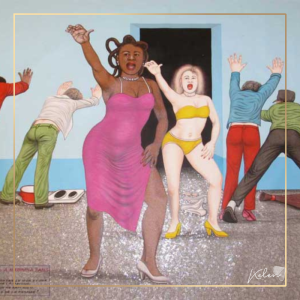 A Day on 8 March in Madimba / A day of the 8th March in Madimba 1996
The 2000s: the birth of experimental art
The 1990s saw a new turning point with the creation in 2003 of the collective ‘Eza possibles’ (‘It’s possible’, in Lingala). This collective brings together a dozen artists, including Kura Shomali, Pathy Tshindele and Mega Mingiedi Tunga. These artists reject all forms of conventional and established art and advocate an experimental, multidisciplinary and resolutely urban art.
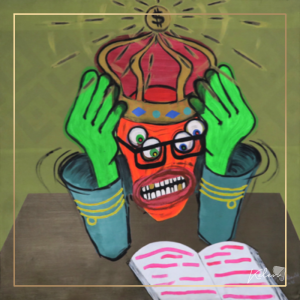 Pathy Tshindele, Untitled, 2016
Today, this diverse group of artists is represented at international exhibitions, making the Congo a leading country in African contemporary art. The success of the “Beauté Congo” exhibition in 2015 at the Fondation Cartier for Contemporary Art in Paris is a case in point.